
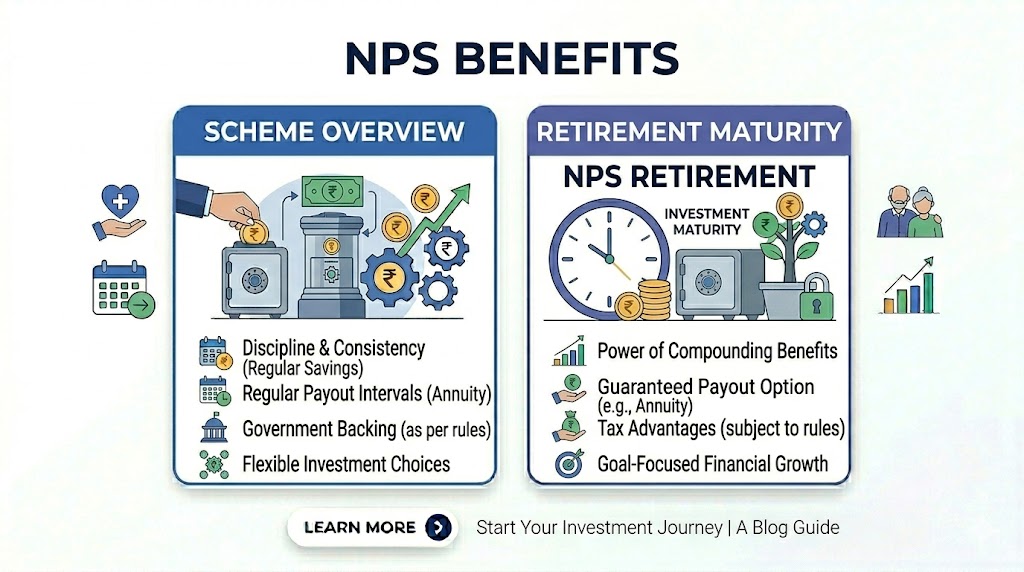
The National Pension Scheme Benefits India have seen a massive overhaul in 2026, making it the most flexible retirement tool in the country. Regulated by the PFRDA, the NPS is no longer just a “lock-and-forget” account. With new rules allowing for 100% lump sum withdrawals for smaller corpuses and the introduction of Silver and Gold ETFs into the portfolio, NPS has transformed into a high-performance wealth generator.
Whether you are a salaried professional looking for that extra ₹50,000 tax deduction or a self-employed individual building a safety net, the National Pension Scheme Benefits India offer a unique mix of equity-linked growth and government-backed security. In 2026, the system even allows you to stay invested until the age of 85, giving your money an additional decade to compound.
Who is this for?
This guide is for all Indian citizens (Resident or NRI) aged 18 to 70. It is especially crucial for high-income earners who want to maximize their tax-saving “blueprint” and for young investors who want to benefit from low-cost professional fund management.
Best ways to National Pension Scheme Benefits India
The most strategic way to leverage National Pension Scheme Benefits India in 2026 is the “80CCD(1B) Push.” While most people stop at the ₹1.5 Lakh limit of Section 80C, NPS allows an exclusive additional deduction of ₹50,000. By utilizing this, you can effectively bring your total taxable income down by ₹2 Lakhs, a benefit not offered by PPF or ELSS.
NPS Benefit Comparison: Tier 1 vs. Tier 2 (2026)
| Feature | NPS Tier 1 (Retirement) | NPS Tier 2 (Savings) |
| Lock-in Period | Until Age 60 (with exceptions) | No Lock-in (Withdraw anytime) |
| Tax Deduction | Up to ₹2 Lakhs (80C + 80CCD) | None (Except for Govt employees) |
| Withdrawal at 60 | 60% Tax-Free / 40% Annuity | 100% Flexible |
| Minimum to Open | ₹500 | ₹1,000 (Requires active Tier 1) |
| Asset Classes | Equity, Corporate Debt, Govt Bonds, Gold/Silver | Same as Tier 1 |
Eligibility Criteria
- Nationality: Must be a citizen of India (Resident or Non-Resident).
- Age: 18 to 70 years at the time of joining.
- KYC: Aadhaar-linked mobile number and a valid PAN card.
- Compliance: Must not have a pre-existing NPS account (Only one PRAN allowed per person).
Documents Required
- PAN Card: Mandatory for financial mapping.
- Aadhaar Card: For instant e-KYC and digital signature.
- Bank Details: Scanned copy of a cancelled cheque or passbook for the PRAN application.
- Digital Signature: Usually captured via Aadhaar-OTP or a scanned image.
Step by Step Process to Apply
- Visit eNPS Portal: Go to the official Protean (formerly NSDL) or KFintech NPS portal.
- Registration: Choose “Individual Subscriber” and enter your Aadhaar/PAN.
- Select Fund Manager: Choose from top-rated managers like HDFC, ICICI, or SBI Pension Funds.
- Choose Investment Choice: * Auto Choice: Portfolio rebalances automatically based on your age.
- Active Choice: You decide the % split between Equity (up to 75%), Corporate Debt, and Bonds.
- Payment: Make the initial contribution (minimum ₹500).
- PRAN Generation: Your Permanent Retirement Account Number (PRAN) will be generated instantly.
Tips to National Pension Scheme Benefits India faster
To reach your retirement goals faster, utilize the “Multiple Scheme Framework.” In 2026, you can now invest in Gold and Silver ETFs (up to 5% of the equity portion), providing a hedge against market volatility that was previously unavailable in NPS.
The 2026 “Magic Number”: ₹8 Lakh
A major update in National Pension Scheme Benefits India for 2026 is the ₹8 Lakh Exit Rule. If your total accumulated corpus at retirement is ₹8 Lakh or less, you are now permitted to withdraw the entire 100% amount as a lump sum, completely bypassing the mandatory annuity (pension) purchase. This provides massive liquidity for those with smaller savings.
Common Mistakes to Avoid
- Conservative Bias: Young investors often put too much in Government Bonds. With a 30-year horizon, an “Active Choice” with 75% Equity can yield significantly higher returns.
- Missing the 80CCD(1B): Many forget to claim the additional ₹50,000 deduction during ITR filing.
- Ignoring Tier 2: If you have an active Tier 1, use Tier 2 as a low-cost alternative to Mutual Funds, as it has some of the lowest management fees (approx 0.01%) in India.
Safety Guidelines
The NPS is strictly regulated by the PFRDA (Pension Fund Regulatory and Development Authority). Always ensure you manage your account through official Central Recordkeeping Agencies (CRA) like Protean or KFintech. Never share your PRAN password or OTP with third-party “pension consultants.”
Internal Resources to Improve Your Wealth
- Compare NPS with Tax Saving Mutual Funds India.
- See how Atal Pension Yojana Benefits work for lower-income groups.
- Understand Mutual Fund vs FD India to balance your overall portfolio.
Frequently Asked Questions
Can I withdraw from NPS before 60?
Yes, you can make up to 4 partial withdrawals (25% of your contributions) for specific reasons like children’s education, marriage, or medical emergencies after 3 years of being a member.
What is the “Active Choice” in NPS?
It allows you to specify your own asset allocation. For example:
Portfolio = 75% Equity (E) + 15% Corporate Debt (C) + 10% Govt Bonds (G).
Is NPS maturity amount tax-free?
60% of the corpus withdrawn at age 60 is tax-free. The remaining 40% must be used to buy an annuity; the pension received from that annuity is taxable as per your income slab.
Can I change my Fund Manager?
Yes, you can change your Pension Fund Manager once a financial year and your asset allocation twice a year through your online portal.
Conclusion
The national pension scheme benefits india position it as one of the most powerful retirement planning tools available in 2026. By leveraging the national pension scheme benefits india, investors can combine tax efficiency under the old tax regime with long-term market-linked growth, creating a strong and disciplined wealth-building strategy.
One of the key advantages highlighted in the national pension scheme benefits india is the additional ₹2 lakh tax deduction, which significantly enhances overall returns when used effectively. By starting early and consistently contributing, the national pension scheme benefits india enable individuals to harness the full power of compounding over decades.
Ultimately, the national pension scheme benefits india provide a structured, low-cost, and government-backed pathway to achieving a financially secure and self-funded retirement.