
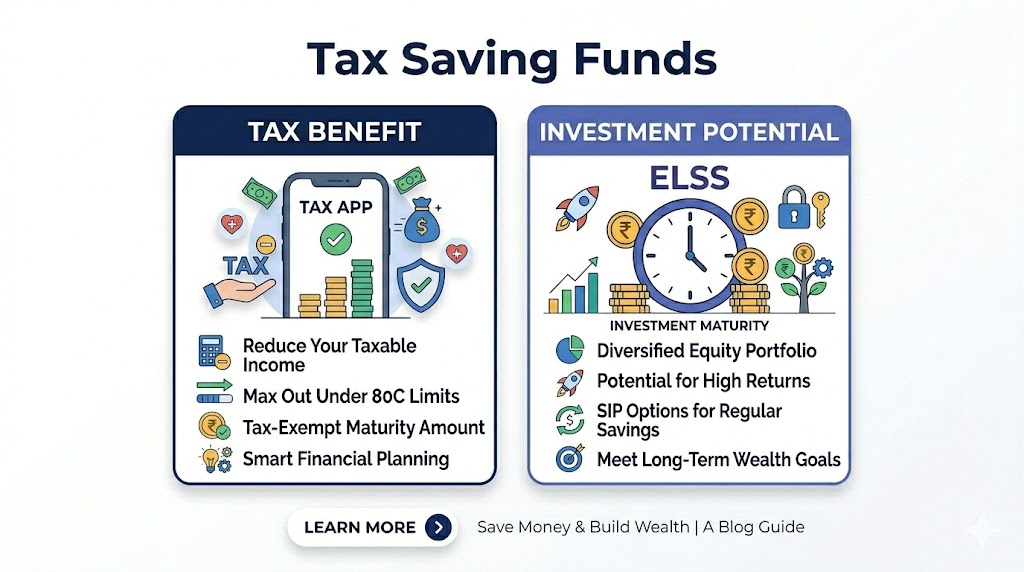
In the 2026 fiscal year, Tax Saving Mutual Funds India, popularly known as ELSS (Equity Linked Savings Scheme), remain one of the most efficient ways to build wealth while reducing your tax liability. Under Section 80C of the Income Tax Act, investors can claim a deduction of up to ₹1.5 Lakh per year. By choosing an ELSS, you can potentially save up to ₹46,800 in taxes annually (for those in the highest tax bracket).
Unlike traditional tax-savers like the 5-year FD or PPF, Tax Saving Mutual Funds India have the shortest lock-in period of just three years. This makes them a favorite for young professionals who want to balance tax efficiency with the high-growth potential of the equity market.
Who is this for?
This guide is for any individual or HUF in India looking to reduce their taxable income while seeking higher returns than fixed-income instruments. It is especially beneficial for salaried employees during the “tax-planning season” (January–March) who need to submit proof of investment to their employers.
Best ways to Tax Saving Mutual Funds India
The most effective way to utilize Tax Saving Mutual Funds India is to start a Systematic Investment Plan (SIP) early in the financial year. Waiting until March often leads to rushed decisions and a heavy one-time financial burden. By spreading your ₹1.5 Lakh investment over 12 months, you benefit from “Rupee Cost Averaging” and ensure that your tax planning is automated and stress-free.
Tax Saving Mutual Funds India Comparison Table (2026)
| Plan Feature | ELSS (Tax Saving MF) | PPF | Tax-Saver FD |
| Lock-in Period | 3 Years | 15 Years | 5 Years |
| Returns (Approx) | 12% – 15% (Market-linked) | 7.1% (Fixed) | 6.5% – 7.5% (Fixed) |
| Tax Benefit | 80C (Up to ₹1.5L) | 80C (Up to ₹1.5L) | 80C (Up to ₹1.5L) |
| Post-Taxation | 12.5% LTCG (Above ₹1.25L) | Tax-Free | Interest is Taxable |
| Risk Category | Moderate to High | Zero (Sovereign) | Low |
Eligibility Criteria
- Individual/HUF: Only individuals and Hindu Undivided Families are eligible for 80C benefits via ELSS.
- KYC Compliance: Must have a SEBI-registered KYC (Aadhaar and PAN linked).
- Tax Regime: Tax benefits are only applicable under the Old Tax Regime. (Note: The New Tax Regime does not offer 80C deductions).
- Bank Account: An active Indian bank account for SIP or Lumpsum transfers.
Documents Required
- PAN Card: Mandatory for all mutual fund transactions.
- Aadhaar Card: For e-KYC and identity verification.
- Bank Statement/Cancelled Cheque: To link your bank account for redemptions.
- Proof of Investment: The “Account Statement” or “Transaction Summary” provided by the fund house to submit for tax deduction.
Step by Step Process to Apply
- Evaluate 80C Gap: Check how much of your ₹1.5 Lakh limit is already filled by EPF or insurance premiums.
- Select a Fund: Choose a top-rated Tax Saving Mutual Fund India based on its 5-year and 10-year performance history.
- Complete e-KYC: Use an investment app to verify your identity instantly using Aadhaar.
- Choose SIP or Lumpsum: Decide if you want to invest a large sum at once or set up a monthly debit.
- Submit Application: Pay the initial amount via UPI or Net Banking.
- Download Receipt: Save the tax-saver certificate for your employer or ITR filing.
Tips to Tax Saving Mutual Funds India faster
To maximize your gains, look for “Direct Plans” rather than “Regular Plans.” Direct plans have a lower expense ratio because they don’t pay commissions to agents, which can add up to 0.5%–1% more in returns every year for you.
Understand the “Unit-Based” Lock-in
A common mistake in Tax Saving Mutual Funds India is assuming the entire investment is free after 3 years. If you invest via SIP, every single monthly installment has its own 3-year lock-in period. For example, an SIP made in April 2026 can only be withdrawn after April 2029.
Common Mistakes to Avoid
- Last Minute Investing: Investing a large sum in March without checking the market valuation.
- Stopping After 3 Years: Just because the lock-in ends doesn’t mean you must withdraw. Let it grow if you don’t need the money.
- Ignoring the New Tax Regime: Ensure you are actually filing under the Old Tax Regime; otherwise, ELSS offers no tax benefit.
- Over-diversifying: Investing in 5 different ELSS funds is unnecessary. One or two high-performing funds are enough.
Safety Guidelines
Ensure you only invest through platforms registered with SEBI (Securities and Exchange Board of India). When comparing Tax Saving Mutual Funds India, check the fund’s AUM (Assets Under Management) to ensure it is a stable, well-established scheme. Never share your portfolio login credentials or OTPs with anyone claiming to be a “tax consultant.”
Internal Resources to Improve Your Loan Approval
- Compare ELSS against other Investment Options for Beginners India.
- Understand how Mutual Fund vs FD India impacts your long-term wealth.
- Learn How SIP Works India to automate your tax planning.
Frequently Asked Questions
What is the maximum limit for Tax Saving Mutual Funds India?
While you can invest any amount, the tax deduction benefit is capped at ₹1.5 Lakh under Section 80C.
Is ELSS interest tax-free?
Mutual funds don’t give interest; they give capital gains. Long-Term Capital Gains (LTCG) above ₹1.25 Lakh per year are taxed at 12.5%.
Can I withdraw ELSS before 3 years?
No. The 3-year lock-in is mandatory and cannot be broken even with a penalty, making it a very disciplined investment.
How do I calculate my potential tax savings?
Tax Saving = Invested Amount (up to 1.5L) x Your Tax Slab Rate.
If you invest ₹1,50,000 and are in the 30% bracket:
Tax Saved = 1,50,000 × 0.30 = ₹45,000 (plus cess).
Conclusion
Tax Saving Mutual Funds India offer a unique “double benefit”—they reduce your current tax bill while providing the historical growth of equity markets. By starting your ELSS journey early in the financial year and staying invested beyond the 3-year lock-in, you can transform a tax obligation into a powerful wealth-building tool. Always consult with a tax professional to ensure ELSS aligns with your chosen tax regime for the year.