
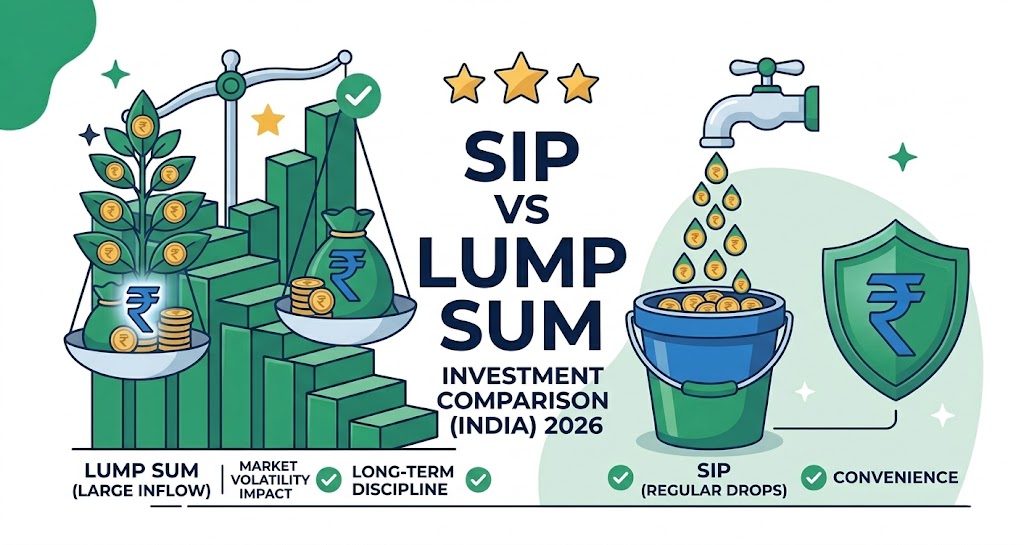
In 2026, the choice between SIP vs Lump Sum Investment India has become a powerful decision for investors navigating a high-velocity market. While Systematic Investment Plans (SIP) are the “gold standard” for disciplined wealth creation, Lump Sum investments offer a seamless way to deploy a large corpus during market corrections. Under the New 2026 Tax Framework, both methods are now subject to a flat 12.5% Long-Term Capital Gains (LTCG) tax for equity gains exceeding ₹1.25 Lakh, making your entry strategy even more essential for maximizing post-tax returns.
Choosing the right path effectively balances risk and opportunity. A SIP is a functional tool that automates your savings and mitigates the risk of “timing the market,” whereas a Lump Sum can provide absolute growth if invested during a bullish cycle. By understanding the reliable mechanics of both, you can ensure your 2026 portfolio remains secure and aligned with your long-term financial goals.
Who is this for?
This guide is for salaried professionals, bonus recipients, and long-term investors in India. If you have a steady monthly income or have recently received a windfall and want to know the absolute best way to invest in 2026, this SIP vs Lump Sum Investment India breakdown is for you.
Comparison: SIP vs Lump Sum Investment India (2026)
The 2026 investment landscape emphasizes automation and tax-efficient exits.
| Feature | SIP (Systematic Investment) | Lump Sum Investment |
| Investment Style | Small, regular installments | One-time large deposit |
| Market Timing | Not required | Crucial for high returns |
| Risk Management | Rupee Cost Averaging | High risk if market drops |
| Ideal During | Volatile or rising markets | Major market corrections |
| Convenience | Instant Auto-debit | Manual one-time execution |
| Psychological Ease | High (Disciplined) | Low (Stressful during dips) |
Key Factors to Consider in 2026
To decide on SIP vs Lump Sum Investment India, prioritize these effective 2026 factors:
1. Rupee Cost Averaging (SIP Edge)
In a volatile 2026 market, SIPs allow you to buy more mutual fund units when prices are low and fewer when they are high. This functional averaging lowers your overall cost of investment without you having to track the Nifty 50 daily.
2. Market Valuation (Lump Sum Edge)
If the Indian market undergoes a significant correction (10-15%), a Lump Sum investment can be powerfully rewarding. Investing a large amount at the “bottom” allows your entire corpus to benefit from the subsequent recovery, whereas a SIP would only be deploying small portions at those low prices.
3. Cash Flow and Discipline
For most 2026 earners, a SIP is the most reliable method to build wealth because it syncs with monthly salaries. It removes the temptation to “wait for a dip,” ensuring your money starts compounding instantly.
Step-by-Step Process to Choose (2026)
- Check Market P/E: If markets are at an all-time high, start a SIP. If they are undervalued, consider a Lump Sum.
- Evaluate Surplus: For a bonus or inheritance, a Lump Sum is functional. For monthly savings, a SIP is better.
- Digital KYC: Use a trusted SEBI-registered app to complete your Video-KYC instantly.
- Verify Bank Link: Ensure your Aadhaar Bank Linking India is active to enable secure SIP mandates.
- Set Up STP: If you have a large amount but fear volatility, put it in a Liquid Fund and use a Systematic Transfer Plan (STP) to move it into equity seamlessly.
Tips for a Successful Strategy
To make your investments truly valuable, consider a “Hybrid Approach.” Keep your monthly SIPs running for discipline, but keep a “Cash Reserve” to make Lump Sum additions during market crashes. Additionally, performing a PAN Card Correction Online India ensures that your tax-harvesting efforts are accurately reported under the new 12.5% LTCG rules. If you move houses, update your Voter ID Status Check India to ensure your permanent address proof in your KYC remains functional and compliant.
The “Tax Harvesting” Benefit
In 2026, regardless of your method, you should sell and reinvest units to utilize the ₹1.25 Lakh tax-free limit. This is a powerful way to reset your purchase price and reduce future tax liability.
Common Mistakes to Avoid
- Timing the SIP: Don’t stop your SIP when the market falls; that is the most essential time to keep it running.
- Lump Sum at Peaks: Avoid investing your entire life savings into equity when the market is at a record high; use an STP instead to remain secure.
- KYC Mismatch: Ensure your mobile number matches your Aadhaar Bank Linking India records to prevent transaction failures during high-volatility days.
Safety & Security Guidelines
The SEBI (Securities and Exchange Board of India) regulates both investment routes. In 2026, all digital platforms must use RBI-mandated risk-based authentication. Always invest through trusted official apps and never share your portfolio login or OTP with “unverified investment gurus.”
Internal Resources for Investors
- Use Aadhaar Bank Linking India to enable instant SIP auto-debits.
- Perform a PAN Card Correction Online India for accurate tax reporting on capital gains.
- Verify your Voter ID Status Check India for updated KYC address verification.
Frequently Asked Questions
Which is better for long-term wealth, SIP or Lump Sum?
Historically, a Lump Sum invested at the right time outperforms a SIP. However, for 90% of investors, a SIP is better because it is more reliable and removes the risk of poor market timing.
Can I switch from a SIP to a Lump Sum?
Yes. In 2026, you can keep your SIP running and make “Additional Purchases” (Lump Sum) in the same fund instantly through your app whenever you have extra cash.
What is an STP (Systematic Transfer Plan)?
It is a functional middle ground. You invest a lump sum in a safe Liquid Fund and “transfer” a fixed amount into an Equity Fund regularly, combining the benefits of both worlds.
Is there a penalty for missing a SIP date in 2026?
While the Mutual Fund house doesn’t charge a penalty, your bank might charge “ECS Return” fees. Always ensure your account balance is sufficient.
Conclusion
Deciding on SIP vs Lump Sum Investment India is a crucial financial choice that depends on your current cash surplus, risk appetite, and market conditions in 2026. Understanding SIP vs Lump Sum Investment India helps you align your investment strategy with both short-term opportunities and long-term wealth creation goals.
When evaluating SIP vs Lump Sum Investment India, SIPs offer disciplined, consistent investing with rupee cost averaging, while lump sum investments allow you to capitalize on market timing and growth potential. A balanced approach to SIP vs Lump Sum Investment India can help you maximize returns while managing risk effectively.
By combining the discipline of SIPs with the strategic advantage of lump sum investing, SIP vs Lump Sum Investment India becomes a powerful framework for building a strong and lasting financial legacy. Choosing the right strategy in SIP vs Lump Sum Investment India ensures you stay aligned with your financial goals across different market cycles.
To succeed with SIP vs Lump Sum Investment India, choose a trusted investment platform, remain consistent with your plan, and review your portfolio regularly. Mastering SIP vs Lump Sum Investment India allows you to confidently navigate the 2026 investment landscape and build long-term financial security with clarity and confidence.