
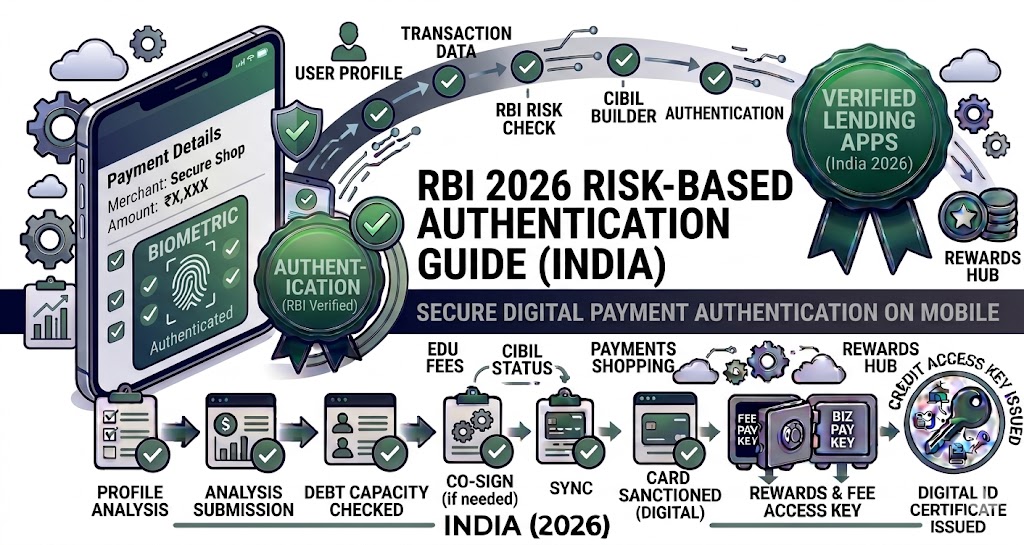
In 2026, the digital finance landscape in India has undergone a massive security overhaul. With the Reserve Bank of India (RBI) enforcing new “Authentication Mechanisms” as of April 1, 2026, the way you protect your money has changed. Static passwords and simple SMS OTPs are being phased out in favor of more robust, dynamic systems. Following updated online banking safety tips India 2026 is no longer just a recommendation—it is a necessity to navigate a world of AI-driven fraud and sophisticated phishing. [Run a Security Check on Your Account]
New RBI 2026 Security Framework
The latest online banking safety tips India 2026 are centered around the RBI’s shift toward Risk-Based Authentication.
- Dynamic 2FA: For all non-card transactions, at least one factor of your Two-Factor Authentication (2FA) must now be “dynamic” (unique to that specific transaction and instantly invalidated).
- Device Binding: Your banking apps are now cryptographically linked to your specific smartphone. If you change your phone, you must go through a “re-binding” process, which is a key part of online banking safety tips India 2026.
- Risk Scoring: In 2026, banks use AI to score every transaction in real-time. If you suddenly try to send ₹1 Lakh from a new location, the system will trigger additional biometric or hardware-key verification.
Top 5 Online Banking Safety Tips India 2026
To stay ahead of cybercriminals this year, implement these high-priority online banking safety tips India 2026:
- Enable Passkeys & Biometrics: Move away from SMS OTPs. Use device-bound passkeys or fingerprint/face recognition, which are much harder for hackers to intercept via SIM-swapping.
- Verify “Mule” Alerts: If your bank’s AI (like the new MuleHunter.AI) flags a transaction or an incoming credit, do not ignore it. Scammers often use innocent accounts to “layer” stolen money.
- Beware of AI Voice Cloning: A rising threat in 2026 is the “Digital Arrest” scam using AI-cloned voices of family members or officials. Always call the person back on their known number before transferring funds.
- Use Official Apps Only: Never download “KYC Update” tools or “Support” apps via links in SMS. Only use apps verified through the official Google Play or Apple App Store.
- Set “Smart” Transaction Limits: Use your app to set daily UPI and IMPS limits. Keeping a lower limit for daily use is one of the most effective online banking safety tips India 2026.
What to Do If You Are Scammed (2026 Rules)
If you fall victim to a fraud despite following online banking safety tips India 2026, the new Compensation Framework (effective July 2026) may protect you:
- Report within 5 Days: You must report the fraud to your bank AND the National Cyber Crime Helpline (1930) within 5 days.
- Small Value Compensation: For genuine losses up to ₹50,000, you may be eligible for a once-in-a-lifetime compensation of up to ₹25,000 or 85% of the loss.
- Institutional Liability: Banks are now held more accountable for “authentication design failures,” shifting the burden of proof away from the customer in many cases.
Internal Resources
- Closing a card is a big move; learn how to improve CIBIL score in India 2026 to offset any score drops.
- If you need cash for an emergency after closing a card, see our loan without bank statement India 2026 guide.
External Resources
- For official safety circulars and the Sachet portal, visit the Reserve Bank of India (RBI) Official Website.
FAQ Section
1. Is SMS OTP still safe for online banking in 2026?
While still in use, it is less secure than app-based tokens or biometrics. Transitioning to biometric-based online banking safety tips India 2026 is highly recommended.
2. Can I use public Wi-Fi for banking in 2026?
It is still risky. If you must, ensure you are using a reputable VPN and that your bank’s app has the 2026 “Device Binding” feature active.
3. What is the 3-attempt rule for transactions?
To prevent automated “brute force” attacks, the RBI now mandates a 90-second gap after three failed transaction status checks.
Conclusion
Adopting online banking safety tips Indiais the best way to leverage the convenience of digital payments without the fear of theft. By staying informed about the RBI’s new risk-based checks and maintaining a high level of personal vigilance, you can ensure your hard-earned money stays exactly where it belongs—in your account.