
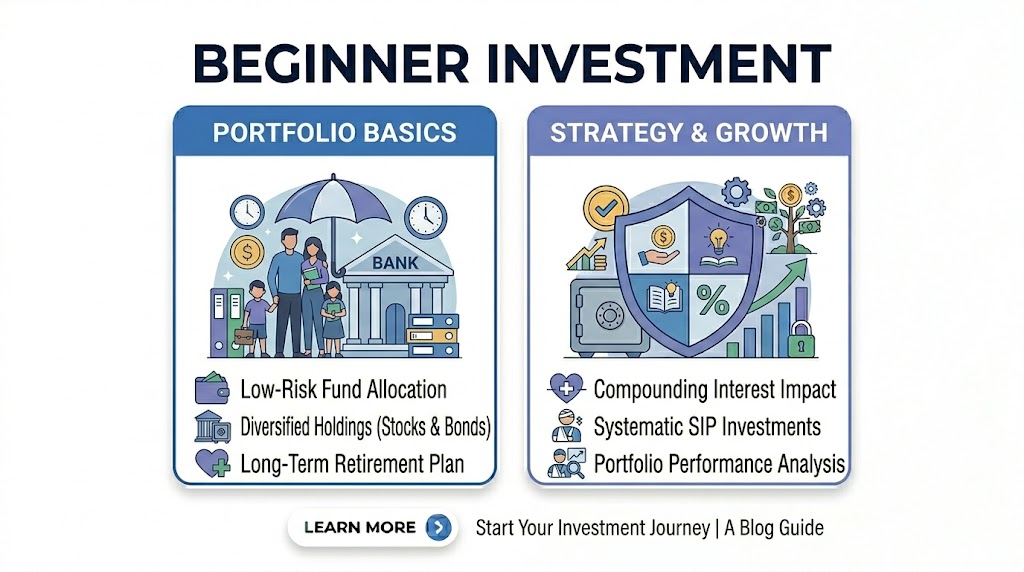
The landscape of Investment Options for Beginners India in 2026 is more accessible than ever, blending traditional safety with modern digital convenience. For those just starting their wealth-creation journey, the goal is to balance risk with consistent returns. With inflation-beating products now available at the click of a button, beginners can move beyond simple savings accounts to build a diversified portfolio that secures their long-term financial future.
In 2026, “Micro-investing” has become a major trend, allowing you to start with as little as ₹100 in mutual funds or digital gold. Whether you prefer the sovereign guarantee of government-backed schemes or the high-growth potential of the stock market, understanding the various Investment Options for Beginners India is the first step toward achieving financial independence.
Who is this for?
This guide is tailored for young professionals, students, and first-time earners in India who want to grow their savings. It is ideal for those who have a small surplus at the end of the month and are looking for safe, regulated ways to enter the world of investing without needing expert financial knowledge.
Best ways to Investment Options for Beginners India
The most effective strategy for Investment Options for Beginners India is the Systematic Investment Plan (SIP). By investing a fixed amount every month, you benefit from “Rupee Cost Averaging,” which lowers your average purchase price over time. Additionally, beginners should leverage tax-saving instruments like the Public Provident Fund (PPF) or Sukanya Samriddhi Yojana (SSY) to ensure their growth isn’t eaten away by taxes.
Investment Options for Beginners India Comparison (2026)
| Investment Type | Current Interest/Returns (Approx) | Risk Level | Minimum Amount |
| Public Provident Fund (PPF) | 7.1% p.a. | Low (Govt) | ₹500/year |
| Mutual Fund (Equity SIP) | 12% – 15% p.a. (Historical) | Moderate/High | ₹100/month |
| Fixed Deposits (FD) | 6.9% – 7.5% p.a. | Low | ₹1,000 |
| Digital Gold | Market Linked | Moderate | ₹1 |
| Sukanya Samriddhi (SSY) | 8.2% p.a. | Low (Govt) | ₹250/year |
Eligibility Criteria
- Residency: Must be a resident of India (NRIs have specific rules for PPF/Fixed income).
- Documentation: Active PAN Card and Aadhaar Card are mandatory for all regulated investments.
- Banking: A valid savings bank account with net banking or UPI enabled.
- Age: Individuals above 18 (Minors can invest through legal guardians).
Documents Required
- Identity Proof: Aadhaar Card and PAN Card.
- Address Proof: Voter ID, Passport, or Aadhaar.
- Bank Details: Cancelled cheque or passbook copy for setting up SIP mandates.
- Photograph: Digital photo for e-KYC on investment apps.
Step by Step Process to Start
- Define Your Goal: Determine if you are saving for a short-term goal (like a trip) or long-term (like retirement).
- Complete KYC: Download a SEBI-registered investment app and complete your digital KYC using Aadhaar and PAN.
- Start with Low Risk: Allocate your first few thousands into a PPF or a Liquid Mutual Fund to build an emergency buffer.
- Set up an SIP: Choose a “Flexi-cap” or “Index Fund” and set a monthly auto-debit date (ideally right after your salary date).
- Diversify with Gold: Use Digital Gold or SGBs to add a small percentage (5-10%) of stability to your portfolio.
- Monitor Regularly: Check your portfolio performance quarterly, but avoid making frequent changes based on daily market news.
Tips to Investment Options for Beginners India faster
To grow your wealth faster, utilize “Step-up SIPs.” By increasing your monthly investment by just 10% every year as your salary increases, you can potentially double your final corpus compared to a flat monthly investment.
Leverage the 8.2% SSY Rate for Daughters
If you have a daughter under the age of 10, the Sukanya Samriddhi Yojana (SSY) is currently one of the highest-yielding Investment Options for Beginners India. With a tax-free interest rate of 8.2% (as of April 2026), it significantly outperforms traditional Fixed Deposits and offers the “Triple E” tax benefit (Exempt on investment, interest, and maturity).
Common Mistakes to Avoid
- Chasing “Hot” Tips: Avoid investing in specific stocks based on social media hype; stick to diversified funds.
- Ignoring Inflation: A 5% return is a loss if inflation is 6%. Always look for real returns.
- Starting Too Late: The “Cost of Delay” is high. Investing ₹1,000 at age 20 is often worth more than ₹5,000 started at age 40.
- Not Having an Emergency Fund: Never invest your rent or grocery money; ensure you have 3-6 months of expenses in a liquid account first.
Safety Guidelines
Always ensure that you are using platforms regulated by SEBI (Securities and Exchange Board of India) or the Reserve Bank of India (RBI). Be cautious of “Digital Gold” platforms that are not backed by reputable refiners like MMTC-PAMP. Never share your trading password or OTP with anyone claiming to be a “wealth manager.”
Internal Resources to Improve Your Loan Approval
- Check Savings Account Interest Rates India to keep your emergency fund earning.
- Use a Loan EMI Calculator Guide India to see how investments can help pay off debt.
- Review Pre-approved Personal Loan in India for liquidity options while your money grows.
Frequently Asked Questions
Is it safe for beginners to invest in the stock market?
Yes, if done through Mutual Funds (SIPs), the risk is diversified across many companies, making it safer than buying individual stocks.
Which is better, FD or PPF?
For long-term goals (15 years), PPF is better due to tax-free compounding. For short-term goals (1-3 years), an FD is better for liquidity.
What is the minimum amount for an SIP?
In 2026, many fund houses allow you to start an SIP with as little as ₹100 per month.
How do I calculate my maturity amount?
You can use the compound interest formula:
A = P × (1 + r/n)^(n × t)
Where:
A = Final amount
P = Principal
r = Interest rate
n = Number of times interest is compounded per year
t = Time in years
Conclusion
Starting with Investment Options for Beginners India is about building a habit of discipline rather than timing the market. By mixing the safety of government schemes like SSY and PPF with the growth potential of SIPs, you create a balanced path to wealth. Start small, stay consistent, and let the power of compounding turn your modest savings into a substantial financial legacy.