
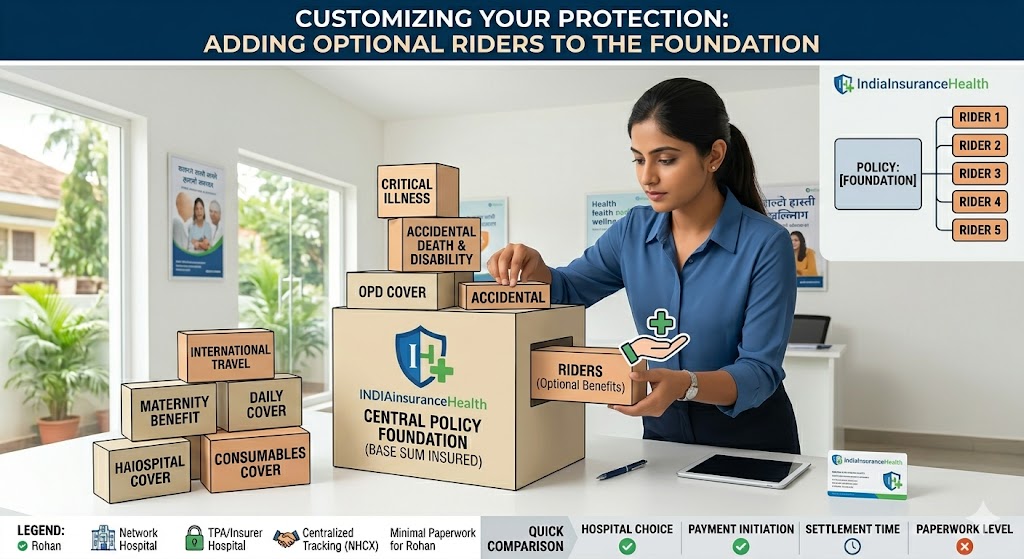
In the 2026 insurance landscape, a “basic” policy is often just the starting point. Insurance riders India 2026 are optional add-ons that act as “turbo-boosters” for your base health or term plan. Instead of buying multiple separate policies, you can attach a rider to your existing plan to cover specific risks like accidents, critical illnesses, or disability. The primary advantage of insurance riders India 2026 is affordability; adding a rider typically costs a fraction of a standalone policy while providing a significant increase in the total sum assured.
Top 5 Essential Riders for 2026
To get the most out of insurance riders India 2026, focus on these high-impact additions:
- Waiver of Premium (WOP) Rider:Perhaps the most critical insurance rider India 2026 offers. If the policyholder is diagnosed with a critical illness or becomes permanently disabled, the insurer waives all future premiums. The policy stays active, but you pay nothing more.
- Critical Illness (CI) Rider:This rider provides a lump-sum payout if you are diagnosed with one of the 30–60 covered illnesses (like Cancer or Kidney Failure). In 2026, many insurance riders India 2026 now include “Early Stage” payouts for specific conditions.
- Accidental Death & Disability Rider:If death or total permanent disability occurs due to an accident, this rider pays an additional sum assured—often doubling the payout of the base plan.
- Family Income Benefit Rider:In the event of the policyholder’s death, this insurance rider India 2026 provides a monthly income to the family for a set period (e.g., 10 years), rather than just a one-time lump sum.
- Hospital Cash Rider:This health-specific rider provides a fixed daily allowance (e.g., ₹2,000/day) during hospitalization to cover non-medical costs like travel or food for attendants.
Tax Benefits of Riders in 2026
One of the most overlooked aspects of insurance riders India 2026 is their tax efficiency under the Income Tax Act:
- Section 80C: Premiums for Accidental Death and Waiver of Premium riders are usually eligible for deductions under the ₹1.5 lakh limit.
- Section 80D: Premiums for Critical Illness and Health riders qualify for deductions up to ₹25,000 (or ₹50,000 for seniors), separate from your 80C limit.
Comparing Standalone vs. Rider (2026)
| Feature | Standalone Policy (e.g., Critical Illness) | Rider Attached to Term Plan |
| Cost | High (Separate Admin Fees) | Low (Add-on pricing) |
| Documentation | Full New Set Required | Minimal (Linked to Base) |
| Renewal | Separate Renewal Date | Auto-renews with Base Plan |
| Customization | Higher Flexibility | Fixed Percentage of Base |
How to Choose the Right Rider?
When evaluating insurance riders India 2026, consider your lifestyle. If you travel frequently, the Accidental Disability rider is a priority. If you have a family history of chronic disease, the Critical Illness rider is non-negotiable.
Expert Tip: In 2026, IRDAI rules state that the total premium for all riders combined cannot exceed 30% of the base policy premium (for life insurance). Use this as a guide to keep your plan balanced and affordable.
Internal Resources
- To ensure you qualify for the best rates, check out our guide on how to improve CIBIL score in India 2026.
- If you need cash for an emergency after closing a card, see our loan without bank statement India 2026 guide.
External Resources
FAQ Section
1. Can I add a rider to an old policy?
Usually, insurance riders India 2026 can only be added at the time of purchase or during the annual policy renewal. Check with your insurer for mid-term additions.
2. Does a Critical Illness rider replace Health Insurance?
No. A CI rider provides a lump sum for lifestyle support, while health insurance covers the actual hospital bills. You need both for full protection.
3. What happens to the rider if I stop paying the base policy?
If the base policy lapses, all insurance riders India 2026 attached to it will also lapse immediately.
Conclusion
Navigating insurance riders India 2026 doesn’t have to be complex. By selecting the right 2-3 riders, you can transform a simple life cover into a comprehensive safety net that protects against death, disease, and disability simultaneously.