
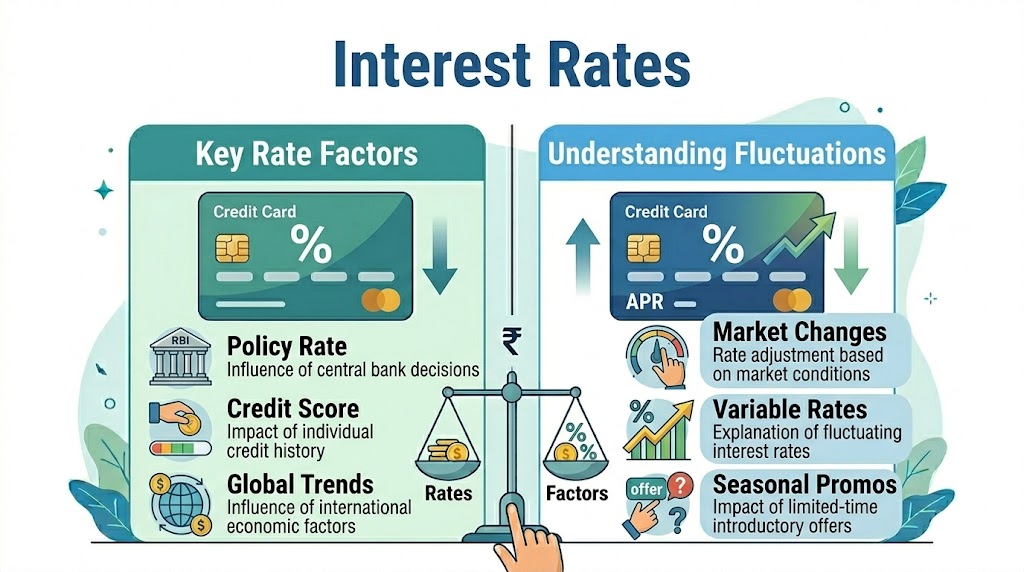
Navigating credit card interest rates india is often the most misunderstood aspect of personal finance. While cards offer a convenient 45-to-50-day interest-free window, the cost of missing a single payment can be astronomical. In 2026, as digital lending scales across India, the average Annual Percentage Rate (APR) for credit cards remains between 36% and 48%, making it the most expensive form of unsecured debt in the country.
However, the Reserve Bank of India (RBI) has introduced landmark transparency reforms this year. Banks are now mandated to provide a clear, one-page Key Fact Statement (KFS) that strips away the jargon, showing you exactly how much interest you pay in Rupee terms, not just percentages. Understanding these credit card interest rates india is no longer just a choice—it’s a survival skill for the modern Indian consumer.
Who is this for?
This comprehensive guide is for every Indian cardholder—from the Gen-Z professional using a RuPay card on UPI to the seasoned executive managing multiple premium cards.
If you have ever carried a balance to the next month or paid only the “Minimum Amount Due,” this article will reveal the hidden math behind your statement. By mastering credit card interest rates india, you can leverage credit as a wealth-building tool rather than a debt trap.
Best ways to manage credit card interest rates india
To manage your debt effectively, you must understand how and when these high rates are triggered.
The “Minimum Due” Trap
Paying the Minimum Amount Due (usually 5% of your bill) only saves you from a late fee. It does not stop the interest. In fact, under credit card interest rates india protocols, the interest for the entire month is applied to your balance the moment you pay less than the full amount.
Loss of Interest-Free Grace Period
If you carry even Rs. 100 as an outstanding balance to the next month, you lose the interest-free period for all new purchases. This means every coffee or grocery bill you swipe for in the new month starts accruing interest at 3.5% per month from the very first day.
Risk-Based Pricing
In 2026, many banks have moved to “Risk-Based Pricing.” This means your credit card interest rates india could be lower (around 1.99% p.m.) if you have a CIBIL score above 800, while someone with a 700 score might be charged 3.75% p.m.
Top Bank Interest Rates Comparison (April 2026)
| Bank / Card Type | Monthly Interest Rate | Annual Percentage Rate (APR) |
|---|---|---|
| IDFC FIRST Wealth | 0.75% – 3.5% | 9.0% – 42.0% |
| HDFC Infinia (Metal) | 1.99% | 23.88% |
| SBI Card Elite | 3.35% | 40.20% |
| ICICI Amazon Pay | 3.50% – 3.80% | 42.0% – 45.6% |
| Axis Bank Ace | 3.60% | 43.20% |
| Standard Chartered Smart | 1.25% – 3.49% | 15.0% – 41.88% |
Eligibility Criteria for Lower Rates
Not everyone has to pay the highest credit card interest rates india. You can qualify for “Low-Interest” cards if you meet these benchmarks:
- Ultra-High CIBIL Score: A score of 780+ often unlocks “Wealth” or “Privilege” cards with rates below 2% p.m.
- Relationship Value: Having a home loan or a high-balance savings account with a bank like HDFC or ICICI can help you negotiate lower credit card interest rates india.
- Corporate Ties: Employees of Fortune 500 companies or Category-A Indian firms often get cards with lower APRs.
- Secured Options: Taking a card against a Fixed Deposit (FD) is the most reliable way to get lower rates if your credit history is thin.
Documents Required to Verify Rates
When you suspect your credit card interest rates india are being calculated incorrectly, keep these documents handy for a dispute:
- Key Fact Statement (KFS): Provided at the time of card issuance.
- MITC Document: The “Most Important Terms and Conditions” (updated April 2026).
- Last 3 Months’ Statements: To track how the Average Daily Balance (ADB) was calculated.
- CIBIL Report: To ensure your “Risk-Based Pricing” matches your current credit health.
Step by Step: How Interest is Calculated
Understanding the math is the only way to truly grasp credit card interest rates india. Most Indian banks use the Average Daily Balance (ADB) method.
- Step 1: Calculate the Daily Rate. If your monthly rate is 3.5%, your daily rate is:Daily Periodic Rate (DPR)=30 days3.5%=0.116% per day
- Step 2: Track Daily Balance. The bank records your balance every single day. If you spent Rs. 50,000 on day 1 and paid back Rs. 10,000 on day 15, your balance was Rs. 50k for 14 days and Rs. 40k for the rest.
- Step 3: Aggregate and Apply. The bank sums up these daily balances, divides by the number of days in the month, and applies the daily rate.
- Step 4: Add GST. In India, all credit card interest rates india attract an additional 18% GST on the interest amount itself.
Calculation Example (April 2026)
If you have an outstanding of Rs. 30,000 at 3.6% p.m.:
- Monthly Interest = Rs. 1,080
- 18% GST on Interest = Rs. 194.40
- Total Finance Charge = Rs. 1,274.40 per month
Advanced Strategies to Lower Your Interest Burden
Convert to Smart EMIs
If you cannot pay the full bill, do not just leave the balance revolving. Use the “Convert to EMI” feature available on almost all nbfc loan apps india and bank portals. While credit card EMIs still carry interest (usually 14-18% p.a.), they are significantly cheaper than the 42% APR of revolving credit.
Use the 3-Day Grace Period
The RBI allows a mandatory 3-day grace period after the due date before a bank can report you as a defaulter to bureaus like CIBIL. However, note that credit card interest rates india may still apply for those 3 days if you don’t pay.
Balance Transfer (BT) Offers
If you have a high balance on one card, look for a “Balance Transfer” offer on another card. Some banks offer 0% to 12% interest for the first 3-6 months to help you clear the debt. This is an effective way to improve credit card approval india for future limits by clearing current debt.
RuPay Credit Cards on UPI: A 2026 Game Changer
One of the biggest shifts in credit card interest rates india involves the rise of RuPay cards. By linking your credit card to UPI, you can now scan any QR code to pay merchants directly from your credit limit.
- Interest-Free Window: You get the same 20-50 days of interest-free credit even on small-ticket UPI spends.
- No Extra Charges: For transactions under Rs. 2,000 at small merchants, there are typically no additional fees for the user.
- MDR Monitoring: The RBI strictly monitors merchant discount rates to ensure credit-on-UPI remains a viable ecosystem for both users and sellers.
Tips to Negotiate Lower Rates Faster
Leverage Your Payment History
If you have been a loyal customer for over 3 years with zero late payments, you are a “High-Value” asset. Call your bank’s customer care and politely ask for a reduction in your credit card interest rates india. Banks would rather lower your rate than lose your business to a competitor.
Monitor Your CIBIL Score Monthly
As banks move toward dynamic risk-based pricing, your credit card interest rates india can literally drop if your credit score jumps from 720 to 800. Use free tracking tools to stay informed and request a rate review from your bank annually.
Request a “Life Time Free” (LTF) Upgrade
Often, banks will waive annual fees and offer lower interest tiers if you agree to upgrade to a higher-variant card that requires a higher spend milestone.
Common Mistakes to Avoid
- Withdrawing Cash from ATMs: This is the #1 mistake. The effective interest rate for cash advances can exceed 50% due to the combination of flat fees and daily interest.
- Ignoring GST: Remember that 18% GST is applicable on all credit card interest rates india, including interest, late fees, and annual fees.
- Revolving Debt During a Dispute: Even if you are disputing a charge, you must pay the “Total Amount Due” to avoid interest. If you win the dispute, the bank will refund the amount as a credit to your next bill.
Safety & Regulatory Guidelines
The RBI does not officially “cap” credit card interest rates india, but it mandates that they must not be “usurious” or “excessive.” Under the 2026 Transparency Guidelines, your bank must notify you via SMS/Email at least 30 days in advance if your interest rate is being increased.
If you feel the charges are unfair or were not disclosed in the KFS, you have the right to escalate to the RBI Integrated Ombudsman. For the official list of protected borrower rights and 2026 billing standards, visit the Reserve Bank of India website.
Internal Resources to Improve Your Financial Health
Mastering your credit profile involves more than just tracking interest:
- Learn how to increase loan eligibility india to qualify for low-APR premium cards.
- If your application was turned down, see the credit card rejection reasons india.
- Considering a cheaper alternative? Read our personal loan vs credit card loan india comparison.
Frequently Asked Questions
Why are credit card interest rates india so high?
Because credit cards are “Unsecured” and “Unstructured.” The bank takes a high risk by giving you instant credit without knowing how you will spend it, and the high rate covers the cost of defaults across the wider market.
Does 0% EMI really mean zero interest?
In most “No Cost EMI” schemes, the interest is actually paid by the merchant as a discount to the bank. However, you still pay GST on that interest and often a small “Processing Fee” of Rs. 99 to Rs. 199.
Can I get a late fee waiver if I missed the date by one day?
Yes. Under the RBI 3-day grace period rule, you should not be charged a late fee if you pay within 3 days of the due date.
Is interest charged on the total limit or the spent amount?
Interest is only charged on the amount you have spent and failed to repay by the due date. Your unused credit limit never attracts interest.
Conclusion
Understanding credit card interest rates india is the difference between being a master of your money or a servant to your debt. While the rates can reach 48% APR, they are entirely avoidable with disciplined, full repayments. Use the transparency of the 2026 RBI rules to your advantage, compare the KFS of different banks, and always prioritize paying off your high-interest credit card debt before any other investment.