
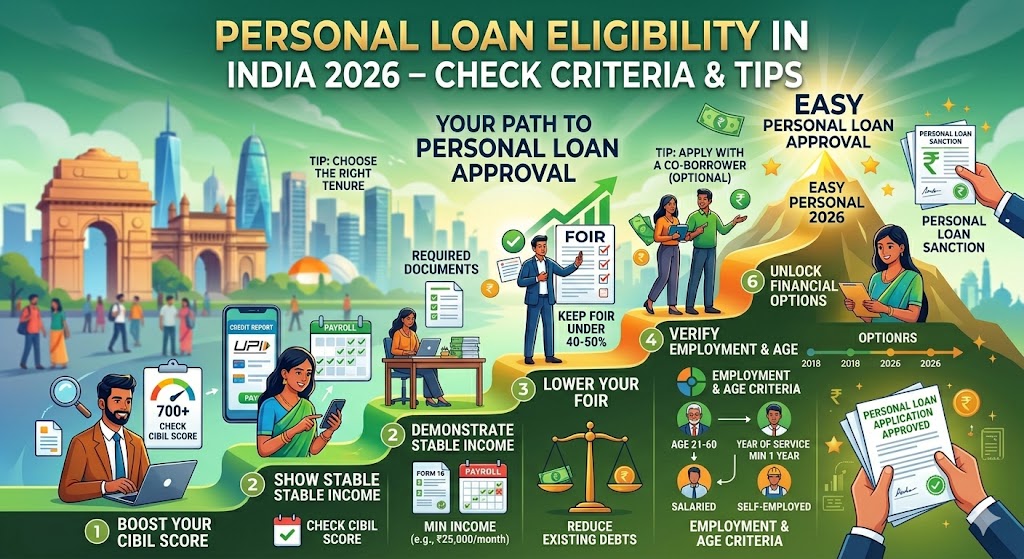
Personal loans are one of the easiest ways to get quick money for your needs. Whether it is for medical emergency, travel, wedding, or any urgent expense, personal loans are widely used in India.
But before applying, it is important to understand eligibility criteria. If you know the requirements, your chances of approval become much higher.
In this guide, we will explain everything in simple terms.
What is a Personal Loan?
A personal loan is an unsecured loan.
This means:
- You do not need to give any security (like gold or property)
- Banks give loan based on your income and credit history
You can use the money for any purpose.
Why Banks Check Eligibility
Banks want to ensure that:
- You can repay the loan on time
- You are financially stable
- There is low risk of default
So they check certain conditions before approving your loan.
Basic Personal Loan Eligibility Criteria in India
1. Age Requirement
- Minimum age: 21 years
- Maximum age: 58–60 years (depends on bank)
2. Income Requirement
- Salaried: ₹15,000–₹25,000/month minimum
- Self-employed: ₹2–5 lakh annual income
Higher income = higher chances of approval
3. Employment Type
- Salaried employees (preferred by banks)
- Self-employed professionals and business owners
Stable job or business is important.
4. Work Experience
- Salaried: At least 6–12 months experience
- Self-employed: Business stability of 1–2 years
5. CIBIL Score
Very important factor.
- 750+ → Excellent
- 700+ → Good
- Below 650 → Risky
Higher score = better approval and lower interest
6. Existing Loans
Banks check your current loans and EMIs.
If you already have many loans, your chances reduce.
7. Debt-to-Income Ratio (DTI)
This means how much of your income goes into EMIs.
Example:
Salary = ₹50,000
EMIs = ₹25,000
DTI = 50% (high)
Ideal DTI should be below 30–40%.
Documents Required for Personal Loan
For Salaried Individuals
- PAN card
- Aadhaar card
- Salary slips (last 3 months)
- Bank statements (last 6 months)
- Employment details
For Self-Employed
- PAN & Aadhaar
- Income proof (ITR)
- Business proof
- Bank statements
How Much Personal Loan Can You Get?
Banks usually offer loan based on your income.
General idea:
- 10–20 times your monthly salary
Example:
Salary = ₹30,000
Loan eligibility ≈ ₹3 lakh to ₹6 lakh
Interest Rates in 2026 (Approx)
- Starting from around 10%
- Can go up to 18% or more
Depends on:
- Credit score
- Income
- Bank policies
Step-by-Step Process to Check Eligibility
Step 1: Check Your CIBIL Score
Use online tools or apps
Step 2: Calculate Your EMI Capacity
Ensure EMI is within 30–40% of your income
Step 3: Gather Documents
Keep all documents ready before applying
Step 4: Use Eligibility Calculator
Most bank websites provide this
Step 5: Apply Online or Offline
Choose bank or NBFC
Benefits of Personal Loans
- No collateral required
- Quick approval and disbursal
- Flexible usage
- Minimal documentation
- Easy online process
Disadvantages of Personal Loans
- Higher interest rates than secured loans
- Strict eligibility criteria
- Penalties for late payment
- Can increase debt burden
Tips to Improve Personal Loan Eligibility
1. Maintain Good CIBIL Score
Pay EMIs and credit card bills on time
2. Reduce Existing Debt
Close small loans before applying
3. Increase Income Proof
Show bonuses, incentives, or additional income
4. Apply with Right Lender
Different banks have different criteria
5. Choose Longer Tenure
Lower EMI improves approval chances
6. Avoid Multiple Applications
Too many applications reduce your score
Common Reasons for Loan Rejection
- Low CIBIL score
- Low income
- High existing EMIs
- Job instability
- Errors in documents
Tips for Beginners
- Borrow only what you need
- Compare interest rates before applying
- Read terms and conditions carefully
- Avoid taking loan for luxury expenses
- Always plan repayment before taking loan
- Keep EMI within your budget
When Should You Take a Personal Loan?
Good situations:
- Medical emergency
- Urgent financial need
- Important life events
Avoid for:
- Shopping or luxury items
- Unnecessary expenses
FAQs
1. What is minimum salary for personal loan in India?
Usually ₹15,000–₹25,000 per month, depending on bank.
2. What CIBIL score is required for personal loan?
A score above 700 is preferred, 750+ is ideal.
3. Can I get personal loan without salary slip?
Yes, self-employed people can apply using ITR and bank statements.
4. How quickly can I get a personal loan?
Some banks approve and disburse within 24–48 hours.
5. Can I get loan with low CIBIL score?
Yes, but interest rate will be higher and options limited.
6. Is personal loan safe?
Yes, if you repay on time and borrow responsibly.
Final Thoughts
Personal loans are easy to get, but they should be used wisely.
Before applying, make sure:
- You meet eligibility criteria
- You can repay comfortably
- You understand interest and charges
Simple rule:
Borrow only when needed and repay on time.
If you follow this approach, personal loans can be a helpful financial tool instead of a burden.