
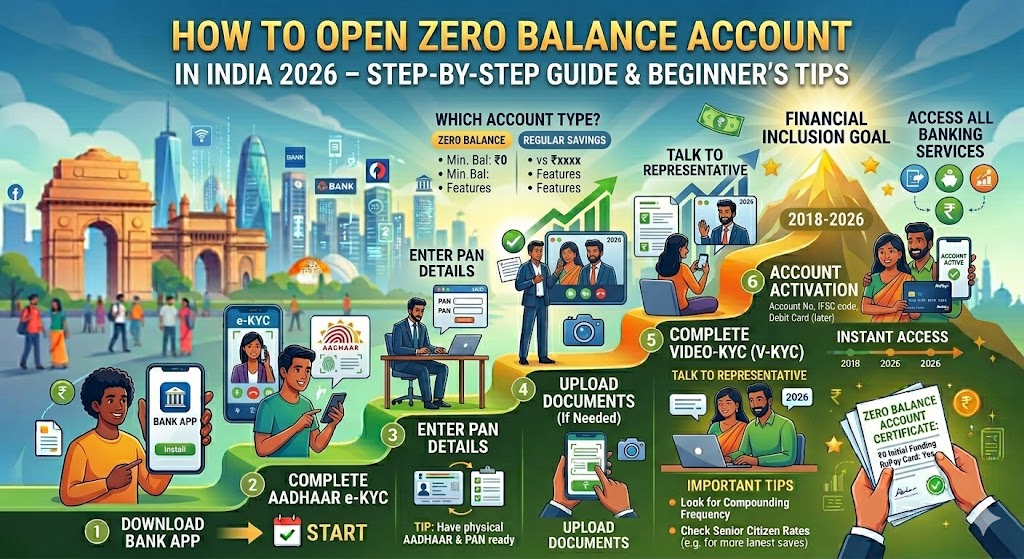
In 2026, opening a Zero Balance Account in India 2026 is the absolute best way to start your financial journey without the stress of monthly maintenance fees. A Zero Balance Account, often called a Basic Savings Bank Deposit Account (BSBDA), is a powerful financial tool that requires absolutely no minimum balance. For the 2026-27 period, these accounts have become the functional standard for students, freelancers, and first-time earners who want secure access to digital banking, UPI, and ATM facilities without the fear of penalties.
The process to secure a Zero Balance Account in India 2026 is now seamlessly digital. With the rise of instant Video-KYC (V-KYC), you can verify your identity and activate your account from the comfort of your home. Whether you are looking to separate your savings from your spending or simply need a trusted account for your UPI transactions, a zero-balance facility offers the absolute freedom to manage your money on your own terms.
Who is this for?
This guide is for students, low-income earners, and anyone looking for a secondary secure account. If you want a functional, penalty-free, and trusted banking experience in 2026, a Zero Balance Account in India 2026 is for you.
Top Banks for Zero Balance Account in India 2026
To understand Zero Balance Account in India 2026 options effectively, compare these absolutely popular choices:
| Bank / Account Name | Primary Feature (2026) | Account Type |
| Kotak 811 Digital | Instant online activation | 100% Digital |
| SBI BSBDA | Highest trusted network | Basic Savings |
| HDFC Basic Account | Secure premium banking | BSBDA |
| Airtel Payments Bank | Fast UPI & digital-first | Payments Bank |
| IndusInd Online | Choose your own account number | Premium Zero Balance |
2026 Strategy: For the absolute best digital experience, Kotak 811 remains a top contender, offering a virtual debit card instantly upon account opening.
Step-by-Step: How to Open Online (2026)
To get your account active instantly, follow this effective digital journey:
- Select Your Bank: Visit the official website or download the trusted mobile app of your chosen bank.
- Fill Basic Details: Provide your mobile number, PAN, and Aadhaar. Ensure your mobile is securely linked to your Aadhaar for OTP verification.
- Enter Personal Info: Fill in your professional and nominee details as part of the seamless application.
- Complete Video-KYC: Have your physical PAN card ready for the instant video call with a bank executive.
- Digital Activation: Once verified, your account is activated instantly. You can now set up UPI and start your journey with a Zero Balance Account in India 2026.
Tips for Successful Digital Banking
To make your account truly valuable, always keep your mobile app updated to the latest 2026 secure versions. Additionally, following our guide on Best Savings Account in India 2026 can help you compare interest rates if you decide to upgrade later. If you are looking to build your financial profile, linking your account to start a How to start SIP in India 2026 is a functional way to grow wealth. For first-time credit seekers, checking your Best Credit Cards in India for Beginners 2026 eligibility can help you get a card linked to your new account. For those needing help with credit health, our guide on How to improve CIBIL score in India 2026 is a secure resource.
The “Auto-Sweep” Advantage
In 2026, check if your zero balance provider offers a “Sweep-in” facility. This powerfully converts any amount over a certain limit into a short-term FD, earning you absolutely higher interest while keeping the balance at zero.
Common Mistakes to Avoid
- Ignoring KYC Deadlines: If you open a “Mini-KYC” account, ensure you complete full V-KYC within 12 months to avoid instant account freezing.
- Overlooking Transaction Limits: Zero balance accounts (BSBDAs) often have an absolute limit of 4 free ATM withdrawals per month.
- Sharing OTPs: Never share your banking OTP with anyone. Banks in 2026 will absolutely never ask for your passwords over the phone.
Related Financial Resources
- Best Savings Account in India 2026: Full list of top-performing banks.
- How to start SIP in India 2026: Grow your savings automatically.
- Personal Loan Eligibility in India 2026: Financial options for account holders.
Frequently Asked Questions
Is it really ₹0 minimum balance in 2026?
Yes. Under the BSBDA guidelines, these accounts absolutely do not require a minimum monthly balance.
Can I have a regular savings account and a zero balance account?
No. Most banks require you to close any existing “Regular Savings Account” in that bank if you want to open a BSBDA/Zero Balance account.
Is a PAN Card mandatory for opening the account?
While some banks allow opening with Form 60, having a trusted PAN card makes the process seamless and faster in 2026.
Can I get a cheque book with a zero balance account?
Yes, but many banks may charge an absolute nominal fee for cheque book leaves in zero-balance variants.
Conclusion
Mastering the Zero Balance Account in India 2026 landscape is a functional priority for anyone seeking a low-cost, high-efficiency banking start. By utilizing secure e-KYC methods and choosing a trusted bank, you can access the modern digital economy instantly. Stay proactive with your Zero Balance Account in India 2026 app notifications, ensure your security is absolute, and use this guide to navigate the Zero Balance Account in India 2026 banking world with absolute confidence.