
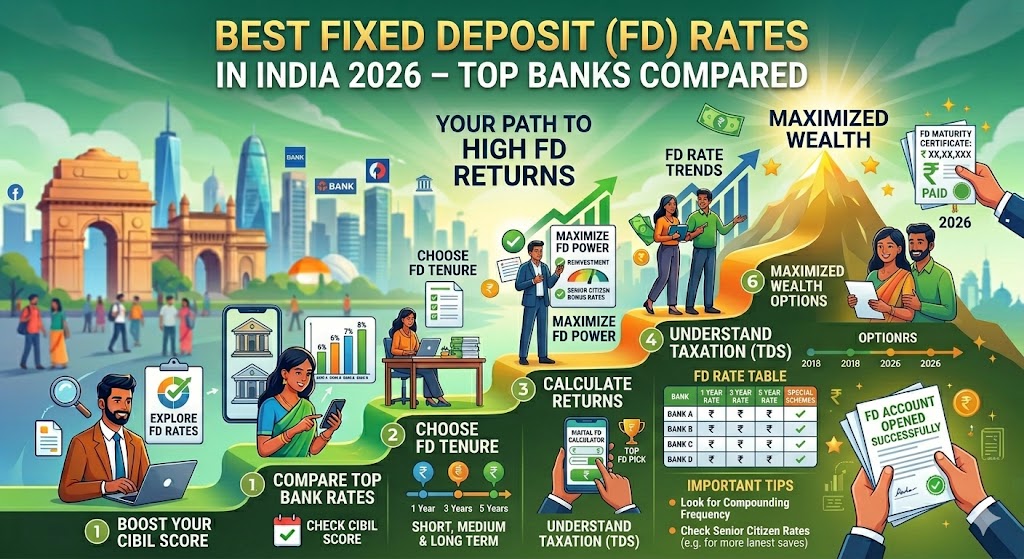
In 2026, securing the Best FD Rates in India 2026 is the absolute cornerstone of a low-risk investment strategy. A Fixed Deposit (FD) is a powerful financial instrument that provides absolute certainty in an unpredictable market. For the 2026-27 period, Indian banks have powerfully adjusted their slabs, offering instant guaranteed returns that often outperform traditional savings accounts. With interest rates peaking between 7% and 8%, especially for tenures of 1 to 3 years, FDs remain a reliable and trusted choice for preserving capital.
Opening a Best FD Rates in India 2026 account has become seamless through mobile banking apps, allowing for instant paperless deposits. Whether you are a conservative investor looking for a secure place to park your surplus or a senior citizen seeking functional monthly income, the 2026 banking landscape offers absolute flexibility in payout frequencies and tenures.
Who is this for?
This guide is for risk-averse investors, retirees, and individuals looking for secure wealth preservation. If you need a functional, high-yield, and trusted savings tool in 2026, the Best FD Rates in India 2026 are for you.
Top 5 Best FD Rates in India 2026
To Best FD Rates in India 2026 effectively, compare the absolute yield offered by these top institutions:
| Bank Name | General Rate (p.a.) | Senior Citizen Rate | Best Tenure (2026) |
| HDFC Bank | 7.25% | 7.75% | 18 – 35 Months |
| SBI | 7.00% | 7.50% | 400 Days (Amrit Kalash) |
| ICICI Bank | 7.20% | 7.70% | 15 Months – 2 Years |
| Axis Bank | 7.30% | 7.80% | 1 Year – 15 Months |
| Unity SFB | 9.00%* | 9.50%* | 1001 Days |
2026 Strategy: For the absolute maximum safety, prioritize “Systemically Important Banks” (SBI, HDFC, ICICI). For the highest functional returns, Small Finance Banks (SFBs) offer rates up to 9%+.
Step-by-Step Online FD Opening (2026)
To get your deposit active instantly, follow this effective digital journey:
- Select Your Bank: Choose a bank from our trusted 2026 list based on your required tenure.
- Login to App/Portal: Access your existing Best Savings Account in India 2026 profile.
- Choose ‘Open FD’: Select the “Fixed Deposit” section and choose between cumulative (reinvestment) or non-cumulative (payout) options.
- Enter Amount & Tenure: Provide the absolute investment sum and the period to see your instant maturity value.
- Confirm & Secure: Authenticate with a secure OTP. Your FD receipt is generated instantly in digital format.
Tips for a Successful FD Portfolio
To make your investment truly valuable, use the “Laddering Strategy”—dividing your total funds into multiple FDs with different tenures to ensure absolute liquidity at regular intervals. Additionally, checking the Best Savings Account in India 2026 to link for your maturity proceeds is a functional priority. If you have a girl child, the Sukanya Samriddhi Yojana 2026 remains a powerfully superior debt option with 8.2% tax-free returns. For those seeking even higher growth, exploring How to Start SIP in India 2026 can help balance your portfolio. If you are starting with zero capital, the How to open zero balance account in India 2026 guide is your absolute first step.
The “DICGC” Safety Net
In 2026, every bank deposit is powerfully insured by the Deposit Insurance and Credit Guarantee Corporation (DICGC) up to ₹5 Lakh (including principal and interest), providing absolute peace of mind.
Common Mistakes to Avoid
- Ignoring Inflation: While FDs are secure, keeping 100% of your wealth in them may not be a functional way to beat long-term inflation.
- Premature Withdrawal: Breaking an FD early often incurs a 0.5% to 1% penalty on the absolute interest rate.
- Taxation Awareness: FD interest is absolutely taxable as per your income slab. Use Form 15G/15H to avoid instant TDS if your income is below the taxable limit.
Related Financial Resources
- Best Savings Account in India 2026: Find the best operational account.
- How to Start SIP in India 2026: For market-linked returns.
- Personal Loan Eligibility in India 2026: Alternatives for urgent liquidity.
Frequently Asked Questions
Which bank gives the highest FD rate in 2026?
Small Finance Banks like Unity and Equitas are powerfully offering the highest rates (up to 9%), while major banks stay around 7.25% for the Best FD Rates in India 2026.
Is a PAN Card required for an FD in 2026?
Yes. To avoid a higher TDS rate of 20%, providing your trusted PAN is an absolute requirement for opening a Fixed Deposit.
Can I get a loan against my FD?
Yes. In 2026, most banks allow you to take an instant overdraft/loan of up to 90% of your FD value without breaking the deposit.
What is the minimum amount for an FD?
Most reliable banks allow you to start an FD instantly with as little as ₹1,000 to ₹5,000.
Conclusion
Mastering the Best FD Rates in India 2026 is a functional priority for anyone looking to build a secure and stable financial base. By utilizing the absolute safety of bank deposits and comparing the trusted rates from top institutions, you can grow your wealth instantly. Stay proactive with your Best FD Rates in India 2026 renewals, ensure your tax forms are absolute, and use this guide to navigate the Best FD Rates in India 2026 investment landscape with absolute confidence.