
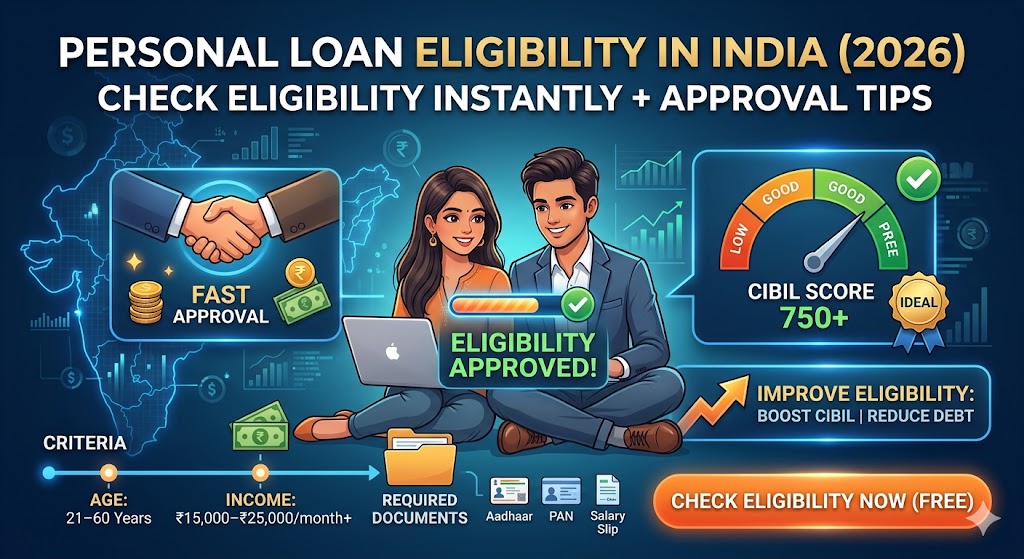
personal loan eligibility tips
Personal loan eligibility in India is the first thing you should check before applying for a loan in 2026. Whether you need funds for emergencies, travel, or debt consolidation, understanding your eligibility helps you get faster approval and better interest rates.
In this guide, you will learn about personal loan eligibility criteria in India, minimum salary for personal loan, required CIBIL score, documents, and expert tips to improve approval chances.
🔥 Check Personal Loan Eligibility Instantly
Looking to get a loan quickly? You can check your personal loan eligibility in India instantly through trusted platforms.
These tools help you find the best lenders based on your profile without affecting your credit score.
📌 What is Personal Loan Eligibility in India?
Personal loan eligibility in India refers to the conditions set by banks and NBFCs to determine whether you qualify for a loan. These conditions include your income, employment type, credit history, and repayment capacity.
Understanding personal loan eligibility in India helps you choose the best lender and get faster approval.
✅ Personal Loan Eligibility Criteria in India (2026)
Here are the standard personal loan eligibility criteria in India:
| Criteria | Requirement |
|---|---|
| Age | 21–60 years |
| Income | ₹15,000–₹25,000/month |
| CIBIL Score | 650+ (750+ ideal) |
| Employment | Salaried / Self-employed |
| Experience | 6 months–1 year |
These criteria may vary slightly depending on the lender.
📊 Minimum Salary for Personal Loan in India (Eligibility Criteria)
The minimum salary for personal loan depends on your location:
Metro Cities: ₹20,000 – ₹25,000/month
Non-Metro Cities: ₹15,000 – ₹20,000/month
Higher income increases your chances of approval and helps you get a higher loan amount.
📉 CIBIL Score for Personal Loan Eligibility in India
Your CIBIL score for personal loan eligibility in India plays a major role:
750 and above: High approval chances with lower interest rates
650 – 750: Moderate approval chances
Below 650: Low approval chances
If your score is low, you should first improve your CIBIL score before applying.
📄 Documents Required for Personal Loan
To apply for a loan, you need:
Identity Proof: Aadhaar Card, PAN Card
Address Proof: Utility bill, Aadhaar
Income Proof: Salary slips or bank statements
Employment Proof: Company ID or offer letter
Having all documents ready ensures faster processing.
🏦 Best Personal Loan Providers in India (2026)
Here are some trusted platforms where you can check eligibility and apply:
Paisabazaar – Compare multiple lenders in one place
BankBazaar – Instant eligibility check
NBFC Apps – Quick approval with minimal documentation
👉 Compare & Apply Now
You can also explore best instant personal loan apps in India for faster approval.
⚡ How to Check Personal Loan Eligibility Online
Follow these steps to check your personal loan eligibility in India:
- Visit a loan comparison platform
- Enter your mobile number
- Fill in your income and job details
- View eligible loan offers instantly
- Choose the best option and apply
The process takes only a few minutes.
📈 How to Improve Personal Loan Eligibility in India
To improve your personal loan eligibility in India:
Improve your CIBIL score
Increase your monthly income
Reduce existing loan burden
Avoid multiple applications
Choose the right lender
These steps can significantly improve your chances of approval.
🚫 Common Reasons for Loan Rejection
Low CIBIL score
Unstable income or job
High existing debt
Incorrect information in application
Avoid these mistakes to improve approval chances.prove approval chances.
🔗 Related Guides You Should Read
If you are planning to take a loan, these guides will help you:
👉 How to improve your CIBIL score in India (2026)
👉 Best credit cards for beginners in India (2026)
👉 Best instant personal loan apps in India (2026)
❓ Frequently Asked Questions (FAQs)
What is the minimum salary required for a personal loan?
You need at least ₹15,000 to ₹25,000 per month depending on the lender.
What CIBIL score is required for a personal loan?
A score of 750 or above is ideal for approval with better interest rates.
Can I get a personal loan with low CIBIL score?
Yes, but approval chances are low and interest rates will be higher.
How long does loan approval take?
Most online platforms provide instant approval within minutes.
📢 Conclusion
Understanding personal loan eligibility in India helps you apply confidently and get faster approval. By maintaining a good credit score, stable income, and proper documentation, you can improve your chances significantly.
You can also check official financial guidelines on RBI website.